
Orchard architecture sets the pace
One of the clearest takeaways from recent mango harvesting research is that the orchard structures delivering the best fruit density and productivity are also the ones that suit mechanical harvesting best.
Slimline, hedged canopies with good fruit display are already proving to be the most cost-effective systems for hand picking. They’re easier on people, faster to work in, and keep feet closer to the ground. As it turns out, those same characteristics also suit mechanical harvesting remarkably well. That’s important, because manual harvesting remains the benchmark any machine has to beat.
Why mechanisation keeps coming back into the conversation
In the recent Mango Matters summer edition, Professor Kerry Walsh and Rafael Goulart outlined key findings from the mango AutoHarvester field trials. They note that, for mangoes, it’s no longer a question of if mechanisation plays a role, but under what conditions it makes sense.
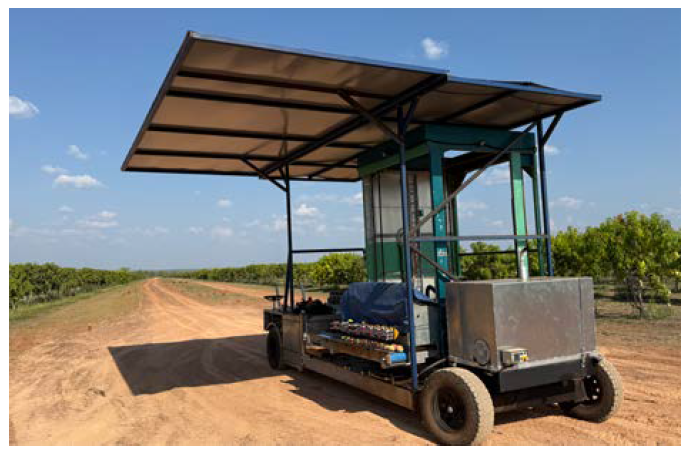
A 2025 season image of Elevator Mk3 on a Niceforo harvest aid base in Katherine, equipped with shade structure for daytime operation & under-arm trampoline to collect dropped fruit.
Across Australian agriculture the labour-intensive jobs on farm have steadily been mechanised, usually when labour becomes harder to find or harder to sustain. However, mango harvesting is still largely manual, often done in high temperatures, and increasingly exposed to labour availability, cost pressure, and health and safety concerns. So let’s see how to get auto harvesting to make sense… and we’ll start with cents per kilo.
The manual benchmark is well understood
From their discussions with growers, current indicative costs for manual harvesting sit roughly at:
- Above 60 c/kg for stalk-on harvest followed by destalking and de-sapping
- Around 25 c/kg using ladders or picking poles
- As low as 12 c/kg when harvesting small, accessible trees with feet on the ground
These figures largely reflect direct labour and don’t capture the full picture of supervision, training, administration, or safety management. Still, they set a clear and very real bar. Any mechanical system needs to be reliable, fast, and suited to real orchard conditions to compete.
What the trials have been showing
Since 2018, the research team has trialled multiple harvesting concepts, eventually progressing to an “elevator” design. This is an array of horizontal picking arms that move vertically across the canopy face. The Elevator Mk3 platform has now been trialled across Rockhampton, Bungundarra, Katherine, and Walkamin. Over multiple seasons, it’s demonstrated solid mechanical robustness, with steady improvements in cycle time, branch avoidance, and performance under variable light.
What’s become increasingly clear is that harvesting performance isn’t just about the machine. Harvesting performance is heavily influenced by canopy structure and tree condition.
Insights from Walkamin
Results from the Queensland DPI Walkamin Research Station were particularly revealing. Their mango density trial included multiple cultivars grown under different canopy architectures, allowing side-by-side comparison.
The patterns were consistent:
- Narrower, higher-density canopies performed better
- Open structures with well-displayed fruit delivered higher success
- Heavy vegetative flush and leaf occlusion reduced efficiency
For the AutoHarvester, in matched architecture conditions, up to 96% of reachable fruit could be successfully detached. Performance dropped noticeably when fruit visibility and access were limited.
These results closely align with DPI Walkamin’s broader findings on orchard design, but especially reinforce that the move toward slimline hedges for improved productivity and manageability supports agtech usage on farm.
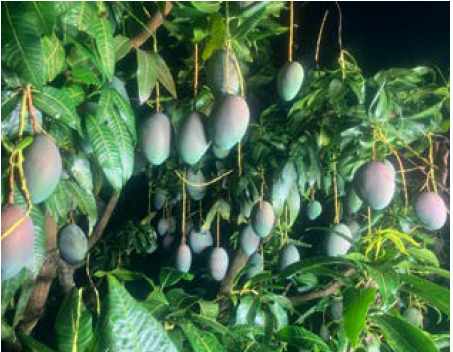
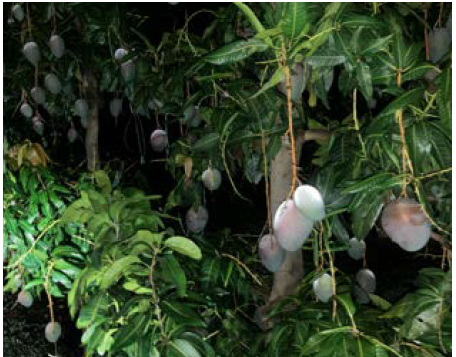
Example canopy for which 96% of reachable fruit were successfully mechanically harvested.
As shown in the images above, the optimum canopy for mechanical harvesting is narrow at <1.5 m half width. Also the fruit is well displayed, without leaf occlusion, and hangs singly rather than in a cluster.
Half the solution is already in the tree
Going through the observations from the trials, it is so encouraging to see that the conditions which help machines get the best mango harvest rate appear to be the same conditions that growers value when harvesting manually.
- Narrow canopies
- Open structure
- Clearly displayed fruit
- Less clustering and congestion
This isn’t about reshaping orchards just to suit a machine. It’s about recognising that modern orchard systems, which are already evolving for yield, consistency, and labour efficiency naturally support mechanisation as well.
Looking ahead
Mechanical harvesting economics will always hinge on speed and efficiency, and gains will continue to come from both machine development and orchard systems evolving together. Return on investment calculations are expected to vary depending on orchard architecture.
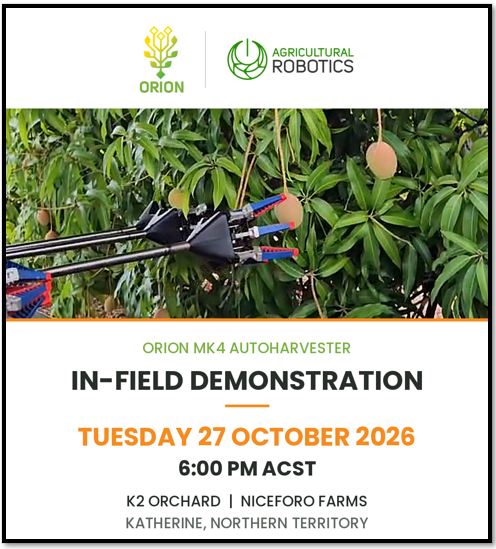
Agricultural Robotics is preparing to return and field test the Mk4 this season, building on what’s been learned so far and continuing to work alongside growers and researchers.
What we’re seeing is that, as orchard systems settle into more consistent structured forms, mechanical mango harvesting starts to look less like a future roadmap and more like a natural next step.